DEPROGRAMMING CODEPENDENT BELIEFS
Written by DarleneLancer
 Codependency is based on false, dysfunctional beliefs that are learned from our parents and environment. Recovery entails changing those beliefs, the most damaging of which is that we’re not worthy of love and respect – that we’re somehow inadequate, inferior, or just not enough. This isinternalized shame. Last year, I published a blog, “Codependency is based on Fake Facts,” explaining the effects of this programming, which squelches our true self. Romantic love that’s mutual can for a brief time liberate our natural, true self. We get a glimpse of what it would be like to live unshackled by shame and fear—why love feels so wonderful.
There are countless ways parents communicate shame—often, with just a look or body language. Some of us were shamed with criticism, told we weren’t wanted, or made to feel we were a burden. In other cases, we inferred that belief from neglect, violation of our boundaries, or dismissal of our feelings, wants, and needs. This can happen even when parents say they love us. Being codependent themselves, shame and dysfunctional parenting gets passed down unconsciously. Bad parenting can also be the result of an addiction or mental illness.
Identify your beliefs
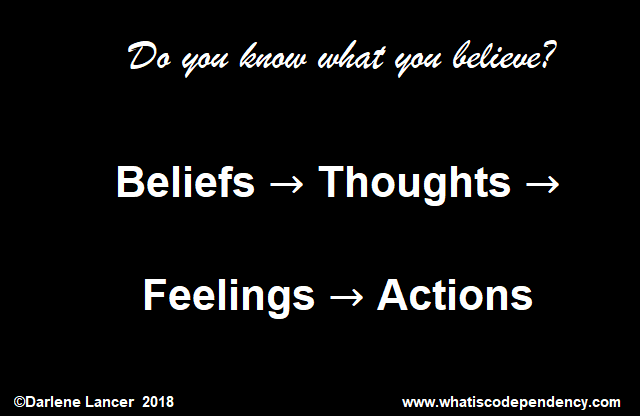
It’s key to recovery that we separate damaging beliefs from reality and from our truth. Like digging through manure, this is how we uncover the gold—our buried true self that’s longing to be expressed. Most of us find it difficult to identify our core beliefs. To a large extent, they’re unconscious. In fact, sometimes, we think we believe something, but when our thoughts and actions (including words), prove the opposite. For example, maybe you know someone who claims to be honest, but who misrepresents or lies when necessary. However, we can discover our beliefs from our behavior, our thoughts and feelings. Beliefs generate thoughts, feelings, and actions. (Sometimes feelings come before thoughts.)
Codependency is based on false, dysfunctional beliefs that are learned from our parents and environment. Recovery entails changing those beliefs, the most damaging of which is that we’re not worthy of love and respect – that we’re somehow inadequate, inferior, or just not enough. This isinternalized shame. Last year, I published a blog, “Codependency is based on Fake Facts,” explaining the effects of this programming, which squelches our true self. Romantic love that’s mutual can for a brief time liberate our natural, true self. We get a glimpse of what it would be like to live unshackled by shame and fear—why love feels so wonderful.
There are countless ways parents communicate shame—often, with just a look or body language. Some of us were shamed with criticism, told we weren’t wanted, or made to feel we were a burden. In other cases, we inferred that belief from neglect, violation of our boundaries, or dismissal of our feelings, wants, and needs. This can happen even when parents say they love us. Being codependent themselves, shame and dysfunctional parenting gets passed down unconsciously. Bad parenting can also be the result of an addiction or mental illness.
Identify your beliefs
It’s key to recovery that we separate damaging beliefs from reality and from our truth. Like digging through manure, this is how we uncover the gold—our buried true self that’s longing to be expressed. Most of us find it difficult to identify our core beliefs. To a large extent, they’re unconscious. In fact, sometimes, we think we believe something, but when our thoughts and actions (including words), prove the opposite. For example, maybe you know someone who claims to be honest, but who misrepresents or lies when necessary. However, we can discover our beliefs from our behavior, our thoughts and feelings. Beliefs generate thoughts, feelings, and actions. (Sometimes feelings come before thoughts.)
Beliefs Thoughts Feelings Actions
Examining our thoughts and feelings provides clues to underlying beliefs. For example, when you don’t keep your body as clean as you like, are you just uncomfortable, or do you feel ashamed or disgusted. What do you say to yourself? Your thoughts might reveal a belief that it’s shameful and disgusting not to shower daily or that bodily odor or fluids are repulsive. Such beliefs indicate a general distaste and shame about the human body. When feel we should or shouldn’t do something, it may indicate a belief. “I should shower daily,” is more of a rule or standard than a belief. The underlying belief might be about the virtues of cleanliness or hygienic well-being. Another way to gain self-awareness is to notice how you judge others. We usually judge other for the same things we would judge ourselves. Criticism and devaluing statements or gestures directed toward children attack their fragile sense of self and worth. They create insecurity and a belief of unlovability. List parental statements that impacted your self-esteem. (See Codependency for Dummies.) Examples are: “You’re too sensitive,” “You can’t do anything right.” “I sacrificed for you.” “You’re good for nothing.” “Who do you think you are?” Beliefs also come from experiences with siblings and peers, as well as other authority figures and cultural, societal, and religious influences. In all, our beliefs are a conglomerate of other people’s opinions. Usually, they’re not based on facts, and they may be challenged. Our over-reactions to people when we’re triggered are perfect opportunities to analyze and challenge the thoughts, feelings, and the beliefs that are being activated. For example, if someone doesn’t return your call, do you feel hurt, guilty, ashamed, or angry? Do you assume they don’t like you, are angry at you, that you did something wrong, or that they’re inconsiderate? What is the story you weave, and what is the underlying belief? A few of the common beliefs codependents hold are:- Other people’s criticisms are true
- People won’t like me if I make a mistake.
- Love must be earned.
- I don’t deserve love and success.
- My wants and needs should be sacrificed for others.
- I must be loved and approved of to feel okay.
- Other people’s opinions carry more weight than mine.
- I’m only lovable if a partner loves me (or at least needs )
- Ask yourself what evidence you have to support your beliefs and thoughts?
- Might you be mistaken or biased?
- Are you certain your interpretations of events are accurate?
- Check out your assumptions by asking people questions.
- Is there any evidence for another point-of-view?
- Are there instances in your experience or in the experience of others that even occasionally contradict your assumptions? Survey people to find out.
- Do people disagree with your conclusions? Find out.
- What would you say to someone else who thought and felt as you did?
- What would a caring friend say to you?
- Do you feel pressured to believe as you do? Why?
- Are you free to change your mind?
- What are the consequences of remaining rigid in your thinking?
- What would be the consequences of changing your mind?
Article author
About the Author
Darlene Lancer is a Licensed Marriage and Family Therapist, author of Codependency for Dummies, and Conquering Shame and Codependency: 8 Steps to Freeing the True You. She's an expert in relationships, codependency, and addiction, having worked with individuals and couples for 27 years. She maintains private practice in Santa Monica, CA and coaches internationally. For more information, see http://www.whatiscodependency.com to receive a FREE Report, "14 Tips for Letting Go," and find links to her books and ebooks, including: "Dealing with a Narcissist," "How to Speak Your Mind - Become Assertive and Set Limits,""I´m Not Perfect-I´m Only Human"- How to Beat Perfectionism and "10 Steps to Self-Esteem: The Ultimate Guide to Stop Self-Criticism." Watch her Youtube, "Codependency: What It Is and What It Feels Like."
You can follow her on Facebook at http://www.facebook.com/codependencyrecovery
Further reading
Further Reading
Article
A Look at Avoidant Attachment Styles and How They Work
The early development of avoidant attachment creates a coping mechanism that forms in childhood. Disconnected parent-child interactions typically trigger this condition. People who develop this attachment style learn to depend on their resources. They avoid deep emotional connections. People with this attachment style want intimacy, yet they remain afraid of becoming dependent on others. Understanding Avoidant Attachment Among the four primary attachment styles, avoidant atta
February 6, 2025
Article
Do You Really Understand The Swinger Life-Style?
So, you want to Play swinging? Do you like the idea of having sex with several attractive people, with no strings attached? Want the chance to explore your fantasies with like-minded people? Love having the intimacy and long-term commitment of your partner, but don't want to miss out on the opportunity for sexual exploration and variety? If this sounds like something you'd like to try, the increasingly popular lifestyle known as 'swinging' could be for you. What's so shocking
August 29, 2024
Article
The Advantages of a Web-Based Swinger Dating Service
Web-based swapping dating services can help you find a long-term swap relationship in the comfort of your home. These types of services can provide singles with information about like-minded people and help them get in touch with other couples. To use dating expertise, you need to register together. When registering to use the service, you need to provide more information as well as your contact information and interests. Maintaining your information conveniently will help yo
August 29, 2024
Article
Dr. Venus Nicolino: You Have To Make Yourself Available To Find Good Relationships
The idea of making yourself more desirable by making yourself less available doesn't make a lot of sense when you think about it. After all, Juliet would have plunged a premature dagger into the heart of her romance with Romeo if she hid in her room rather than go out on her balcony. The end of Sleepless in Seattle shifts from "awww" to "aw, no" if one of the two main characters skips the trip to the Empire State Building. As these examples from fiction show, making yourself
August 16, 2024