Power of Mind: We are what we believe we are
Written by Nataša PantoviÄ
Conscious Parenting and Power of Mind
Parenting Behavior / Style Reward and Punishment: Is Santa Claus myth working?
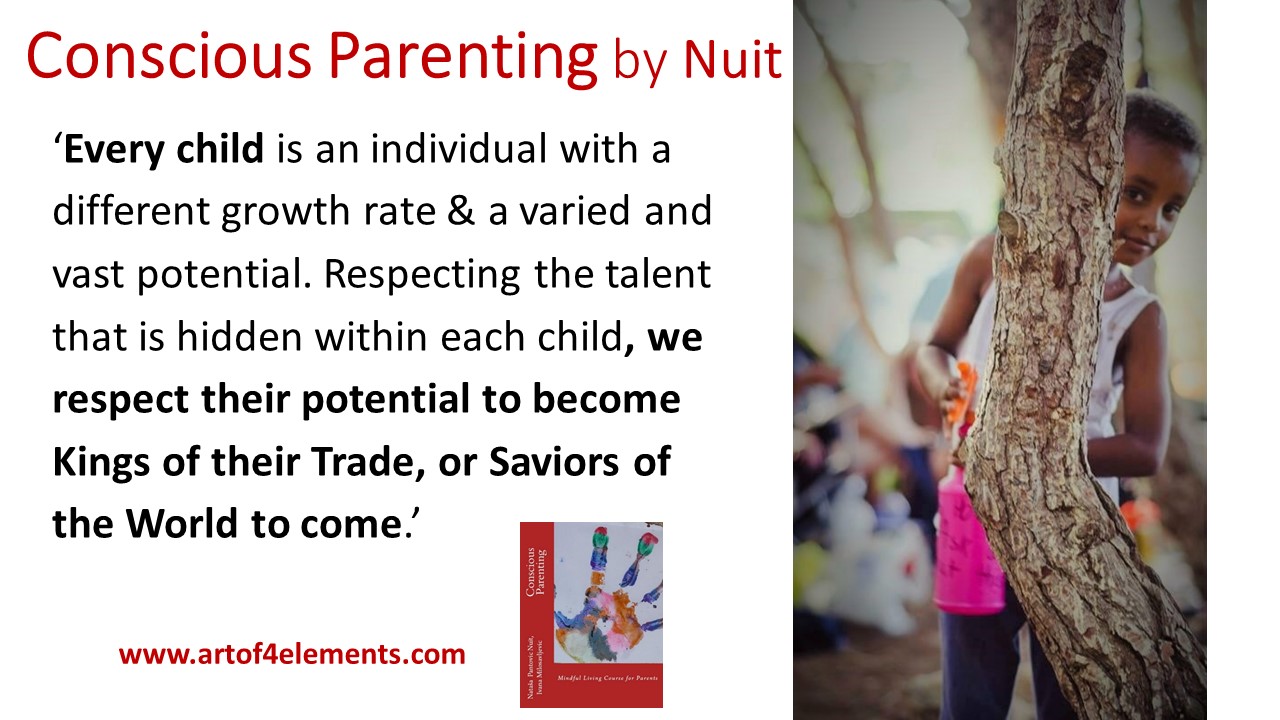 Our basic strategy for raising children or motivating employees is a reward and punishment strategy. From an early age we have our Santa Claus that carefully observes what we do and that appears from heavens to deliver gifts for ‘the good’ ones or to punish the ‘bad ones’. While manipulating children with incentives seems to work in the short run, it is a strategy that ultimately fails. Rewards turn play into work, and work into drudgery.
Praise is frequently a judgment and a kind of bribe as the child or the employee must ‘earn’ the points by doing the ‘right’ thing. If we use encouragement, instead, we give support whether or not one is doing well. We do not take the person out of the zone where s/he feels accepted and capable.
Punishment causes either physical, emotional or social pain and it is often followed with confusion, anger, or guilt. Many children developmental professionals will advise us to ignore young children's bad behavior.
Our basic strategy for raising children or motivating employees is a reward and punishment strategy. From an early age we have our Santa Claus that carefully observes what we do and that appears from heavens to deliver gifts for ‘the good’ ones or to punish the ‘bad ones’. While manipulating children with incentives seems to work in the short run, it is a strategy that ultimately fails. Rewards turn play into work, and work into drudgery.
Praise is frequently a judgment and a kind of bribe as the child or the employee must ‘earn’ the points by doing the ‘right’ thing. If we use encouragement, instead, we give support whether or not one is doing well. We do not take the person out of the zone where s/he feels accepted and capable.
Punishment causes either physical, emotional or social pain and it is often followed with confusion, anger, or guilt. Many children developmental professionals will advise us to ignore young children's bad behavior.
Family and Positive Psychology
 Dr Eveline Crone, a Dutch neuro-scientist, studied children age 8 to 12, giving them a computer task and observing their brains (using fMRI) when they are given a positive, rewarding feedback - a check for well done, and when they are given a cross – punishment for not understanding the rule. The performance of the younger children improved substantially more when the feedback was positive. Their brains reacted strongly to positive feedback and scarcely responded at all to the negative one. Older children and adults react a bit more on the negative feedback, but this fact makes us wonder do we condition our brains to re-act in a particular way to 'win' in a short-term, and makes us ponder about the long term consequences of such brain conditioning.
Parenting and a reward and punishment study that went wrong
A scary psychological study that researched awards and punishment methods and that went horribly wrong happened at the University of Iowa, in 1939, with 22 orphaned children, 10 with stutters. The children were separated into two groups: one with a speech therapist who conducted "positive" therapy by praising their efforts; the other with a speech therapist who openly chastised the children for their mistakes. The results showed that the children who received negative feedback were badly affected during and following the experiment that lasted 6 months, so much so that in 2007, six of them were awarded $925,000 in compensation for psychological damage they suffered.Power of Mind: We are what we believe that we are
What we 'think' and what we 'believe we are', are the two main things that decide whether we will succeed or not in our projects in life. Our mind is responsible for all sorts of illusions. Our mind is to blame for the phenomenon of the placebo effect (a sugar pill effect). When we believe that a certain procedure or medication is effective, we increase the efficacy of that procedure or medication by 50- 60%. Often, our behavior is shaped by subtle pressures around us, but we do not recognize those pressures. According to ‘Self-perception theory’ people decide on their own likes and dislikes from watching themselves behave in various situations. We assume our sense of who we are from our behavior.C.S. Lewis said: ‘We are what we believe we are.’
Primary example is of a very young child that in a grocery store steals a candy bar. Let's say no one notices, the child does not change his self perception of being a good child. Secondary is where the kid gets caught, and the parents make a big deal about it. The child may then think of himself as a thief. This may become the child's self perception and it may become a prophecy.Power of Mind: We might be what we pretend to be
In 1971, social psychologist Philip Zimbardo used a group of students to take part in a two week long experiment in which they would live as prisoners and guards in a mock prison. The results were so disturbing that after just six days, Zimbardo had to end the experiment. Ordinary students turned into sadistic guards and spineless prisoners, becoming deeply emotionally involved within their roles. At an early stage of a child’s development, children’s self esteem is a major factor as to how they view and build their own behavior. By developing emotional intelligence and fostering lasting self-esteem, we prepare them for the future. If our children are to become happy, confident, and in love with knowledge, they need to be supported and assisted in their search for knowledge, and we need to help them behave as eager, creative, and enthusiastic individuals and the self-perception with future behavior will follow.Power of Mind and Learning
When shaping the first Waldorf school, Steiner (the founder of this successful alte ative schooling method) said that there was to be no classification of children into intellectual ‘streams’, no examinations, no holding back in a grade, no prizes, no honor boards, no homework. Teachers were to avoid negative comments in their reports, and talk about the child with humor and appreciative words. Also included in the report was a verse to ‘show the individual child the direction in which he should strive’ (Miller 1982, 64). The original article is published at: https://www.artof4elements.com/entry/95/mind-power To check more Conscious Parenting Articles, please go to: https://www.artof4elements.com/page/our-children
Article author
About the Author
Nataša PantoviÄ MSc Economics, Published Author since 1991, Adoptive Parent, Management Consultant and Ancient Worlds Consciousness Researcher. Author of:
1. Conscious Parenting: Mindful Living Course for Parents,
2. Mindful Being towards Mindful Living
3. Art of 4 Elements spiritual poetry book and
4. A-Ma or Playing Glass Bead Game with Pythagoras.
5. Tree of Life: a Journey into the Field of Dreams
6. Conscious Creativity: Ancient Europe's Mindfulness Meditations
7. Spiritual Symbols with Their Meanings
Artof4Elements launched the AoL Mindfulness Series of 9 fiction and non-fiction books with 7 Authors focusing on ancient history, creativity and comparative religion. A series of many genres, including poetry, personal development, historical fiction, the world of ''AoL Mindfulness'' explores inner alchemy, and reaching ones highest potential..
Further reading
Further Reading
Article
A Course in Miracles: Comprehending The Deep Teachings
"A Training course inside Miracles" (ACIM) can be a non secular text message which includes obtained a devoted pursuing for the strong, transformative teachings. Composed inside the 1970s simply by Medical professional. Sue Schucman, it includes an original way of spirituality, blending together Orlando terms together with emotional and also metaphysical principles. The particular course's goal is always to aid men and women obtain interior peacefulness and also wake for the
September 14, 2024
Article
Locked Steering Wheel Woes: Troubleshooting and Solutions
Embarking on the exploration of a locked steering wheel as a frustrating automotive challenge, we aim to unravel its reasons and provide effective troubleshooting methods. Whether caused by a faulty ignition lock or power steering malfunction, this guide empowers drivers to overcome steering wheel lock woes. Now, if your car shakes when hitting 60 mph, understanding potential causes and solutions becomes equally essential. Join us as we navigate through troubleshooting proces
March 26, 2024
Article
The Art of Patience: Unraveling the Enigma of Summoning Sickness in Magic: The Gathering
Introduction: Magic: The Gathering (MTG) is a complex and strategic card game that has captured the hearts of millions worldwide. One of the intricacies that often perplexes newcomers is the concept of "Summoning Sickness." In this guide, we will delve deep into the realms of what is summoning sickness in mtg , demystifying its essence, and providing a comprehensive understanding for players at all levels. I. Unveiling the Mystery: Summoning Sickness is a term that frequently
February 27, 2024
Article
Crafting Homemade Buttermilk: A Culinary Adventure
Buttermilk, a versatile dairy product, adds a unique tanginess and texture to a variety of dishes. From pancakes to fried chicken, its uses are diverse in the culinary world. In this guide, we'll explore the simple yet rewarding process of making your own buttermilk at home. Ingredients: Before embarking on your buttermilk-making journey, gather the necessary ingredients. All you need is whole milk and an acidic component like lemon juice or white vinegar. The simplici
January 4, 2024