Abbot George Burke (Swami Nirmalananda Giri)
Free
Meditation and Spiritual Life Expert
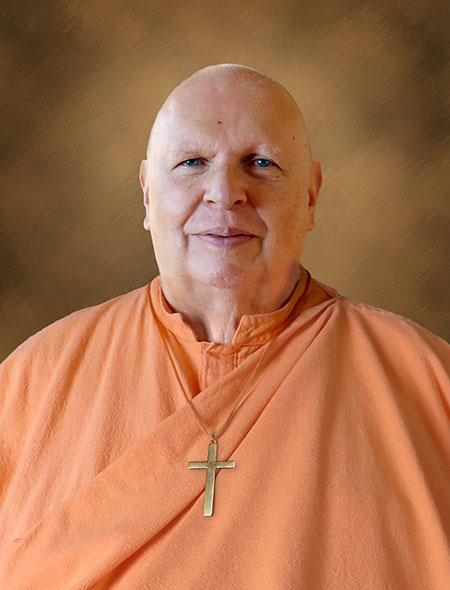
Abbot George Burke (Swami Nirmalananda Giri) Quick Facts
- Main Areas
- practical spirituality
- Best Sellers
- The Christ of India
- Career Focus
- monk
- Affiliation
- Light of the Spirit Monastery
Abbot George Burke (Swami Nirmalananda Giri) is the founder and director of the Light of the Spirit Monastery (Atma Jyoti Ashram) in Cedar Crest, NM, USA.
In his many pilgrimages to India, he had the opportunity of meeting some of India’s greatest spiritual figures, including Swami Sivananda of Rishikesh and Anandamayi Ma. During his first trip to India he was given sannyas by Swami Vidyananda Giri, a direct disciple of Paramhansa Yogananda, who had himself been given sannyas by the Shankaracharya of Puri, Jagadguru Bharat Krishna Tirtha.
In the United States he also encountered various Christian saints, including Saint John Maximovich of San Francisco and Saint Philaret Voznesensky of New York. He was ordained in the Liberal Catholic Church International to the priesthood on January 25, 1974, and consecrated a bishop on August 23, 1975.
For many years, Abbot George has been engaged in deep study of the spiritual unity (actual identity) of Jesus Christ and his teachings with India and Sanatana Dharma. It is his conviction that original Christianity (not contemporary “Churchianity”) and original Yoga are not just compatible, they are essentially one; that Jesus lived in India for most of his life, being a Sanatana Dharma missionary to the West, and that after his resurrection he returned to India and lived the rest of his life in the Himalayas.
He has written extensively on these and other topics, many of which are posted here at OCOY.org. Of major significance are: The Christ of India, The Yoga of the Sacraments and his various commentaries on Indian texts including the Bhagavad Gita and the Upanishads as well as an adaptation of the Bhagavad Gita in English for chanting.
Free Audio & Video Samples
Abbot George Burke (Swami Nirmalananda Giri) Books
The Christ of India: The Story of Saint Thomas Christianity
http://a.co/eEJqtSY
Spiritual Benefits of a Vegetarian Diet
http://a.co/9iFV3Wt
The Gospel of Thomas for Awakening: A Commentary on Jesus’ Sayings as Recorded by the Apostle Thomas
http://a.co/8aEzRYM
The Dhammapada for Awakening: A Commentary on Buddha's Practical Wisdom
http://a.co/f0R5to0
May a Christian Believe in Reinca ation?
http://a.co/1mwbDat
Robe of Light: An Esoteric Christian Cosmology
http://a.co/5FEBVNy
Dwelling in the Mirror: A Study of Illusions Produced by Delusive Meditation and How to Be Free from Them
http://a.co/a1lChmY
Articles by this expert
SelfGrowth articles and saved writing connected to this expert.
Article
From Children of God to ”Dear Children” or How to Grow in Faith
“Be ye therefore followers of God, as dear children” (Ephesians 5:1). Everyone is a child of God, for God is the Source of all. Everyone is beloved to God. So what are dear children? I learned the answer to that from the mouth of a barely educated old lady in the summer of 1958. I was at a church meeting in a tiny, very poor little town in a corner of Oklahoma. During the Sunday School class this verse from Saint Paul was read, and the teacher asked an elderly lady if she would not explain it.
Recently added
Article
The Negative Effects of Misusing Your Power of Thought
“Thinking about sense-objects will attach you to sense-objects; grow attached, and you become addicted; thwart your addiction, it turns to anger; be angry, and you confuse your mind; confuse your mind, you forget the lesson of experience; forget experience, you lose discrimination; lose discrimination, and you miss life’s only purpose.” –Bhagavad Gita 2:62, 63 It is true that the journey of a thousand miles begins with the first step. In these two verses Krishna has described the entire journey, beginning with thought and ending in total loss. Each step should be considered well.r
Recently added
Article
The Scientific Data Behind 4 Practical Benefits of Meditation
Here are four scientific reports about the practical benefits of meditation, the first three being about Breath Meditation specifically:
Recently added
Article
Meditator’s Guide to the Mind—Seven Important Lessons
Mind–the source “Mind precedes its objects. They are mind-gove ed and mind-made” (Dhammpapada 1). First there is the mind. It is possible to view “mind” as both the machinery of perception we have been talking about and the consciousness which perceives the perception, the consciousness that is unconditioned and permanent–in other words, the spirit, the ete al Self. “The Self is ear of the ear, mind of the mind, speech of speech. He is also breath of the breath, and eye of the eye” (Kena Upanishad 2).
Recently added
Websites & resources
SelfGrowth-published websites, downloads, and contributor profile websites connected to this expert.