How to connect a Portable Generator to an Electric Panel
Written by Adam Clapton
 Transfer switch
This is a device that is usually installed near or adjacent to the electric panel and whose purpose is to enable the portable generator to power up the devices in the house. Basically, one connects the transfer switch to the specific circuit(s) in the panel that one needs to receive power during outages. For example, if you wish to power your WIFI router and refrigerator using your generator, ensure that there is a direct connection between the transfer switch and those circuits. The transfer switch receives power from the portable generator and then redirects it to the connected circuits and hence, with the transfer switch, it is unnecessary to use extension cords to power up devices directly.
Whereas transfer switches are not a mandatory requirement unless one lives in the USA where a homeowner who wishes to use generator power is required to have one, these switches have several benefits. The primary benefit of a transfer switch is safety, which arises because the switch isolates the connected circuits on the electric panel from the main power supply. This isolation eliminates the probability of back-feed, which occurs due to the redirecting of power to utility lines- something that can spark fires, shock utility line repair personnel, or irreparably damage the portable generator.
Another benefit is that transfer switches provide a simple, hassle-free way of restoring power during blackouts. Whereas one may use extension cords running from the portable generator to supply power directly to appliances, doing this would require that the appliances be in one area of the home thus creating the hustle of moving them. Besides this, having several wires running throughout the house poses a fire and tripping threat. However, with a transfer switch, none of those connections are necessary making it much easier to use.
Types of switches
Transfer switch
This is a device that is usually installed near or adjacent to the electric panel and whose purpose is to enable the portable generator to power up the devices in the house. Basically, one connects the transfer switch to the specific circuit(s) in the panel that one needs to receive power during outages. For example, if you wish to power your WIFI router and refrigerator using your generator, ensure that there is a direct connection between the transfer switch and those circuits. The transfer switch receives power from the portable generator and then redirects it to the connected circuits and hence, with the transfer switch, it is unnecessary to use extension cords to power up devices directly.
Whereas transfer switches are not a mandatory requirement unless one lives in the USA where a homeowner who wishes to use generator power is required to have one, these switches have several benefits. The primary benefit of a transfer switch is safety, which arises because the switch isolates the connected circuits on the electric panel from the main power supply. This isolation eliminates the probability of back-feed, which occurs due to the redirecting of power to utility lines- something that can spark fires, shock utility line repair personnel, or irreparably damage the portable generator.
Another benefit is that transfer switches provide a simple, hassle-free way of restoring power during blackouts. Whereas one may use extension cords running from the portable generator to supply power directly to appliances, doing this would require that the appliances be in one area of the home thus creating the hustle of moving them. Besides this, having several wires running throughout the house poses a fire and tripping threat. However, with a transfer switch, none of those connections are necessary making it much easier to use.
Types of switches
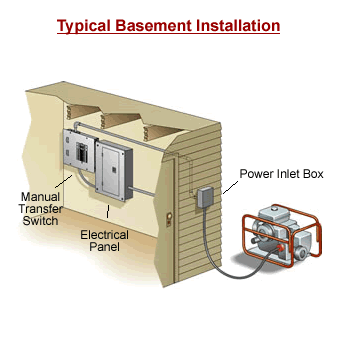 Transfer switches may be either manual or automatic. For manual transfer switches, one is required to go to the electric panel and manually switch on the circuits that one wants to be powered on by the portable generator. Universal or Automatic switches, on the other hand, are directly hardwired onto specific circuits on the electric panel, which ensures that the portable generator automatically begins to supply power to those circuits during an outage. These switches can also be programmed to divert power from one circuit to another if necessary. Whereas automatic switches are more convenient, manual switches are cheaper and do not require installation by professionals, which may be expensive.
Manual switch
The method used to connect the portable generator to the home is dependent on the nature of the transfer switch. When power goes out and one is using a manual switch, the first step is to go to the electric panel and switch all circuits to OFF. Next, one must turn on the portable generator allowing it some few minutes to warm up. After this, one proceeds to the transfer switch and switches the breakers to GENERATOR and then turns the specific circuits that one wants to connect to the portable generator to ON with this being done one by one to avoid overloading the generator. After the restoration of regular power supply, one must go back to the transfer switch where the breakers will be switched to UTILITY and any circuits that were previously switched OFF returned to ON.
Automatic switch
For the automatic transfer switch, most of these steps are unnecessary with the only requirement being that one plugs their portable generator into the inlet box in the home. At this point, an automatic detection of an alte
ate power source by the transfer switch will occur and it will move to GENERATOR mode from the UTILITY status. When power is restored, all one needs to do is to unplug the portable generator from where it was attached in the inlet box and the switch back to UTILITY will occur automatically.
Transfer switches may be either manual or automatic. For manual transfer switches, one is required to go to the electric panel and manually switch on the circuits that one wants to be powered on by the portable generator. Universal or Automatic switches, on the other hand, are directly hardwired onto specific circuits on the electric panel, which ensures that the portable generator automatically begins to supply power to those circuits during an outage. These switches can also be programmed to divert power from one circuit to another if necessary. Whereas automatic switches are more convenient, manual switches are cheaper and do not require installation by professionals, which may be expensive.
Manual switch
The method used to connect the portable generator to the home is dependent on the nature of the transfer switch. When power goes out and one is using a manual switch, the first step is to go to the electric panel and switch all circuits to OFF. Next, one must turn on the portable generator allowing it some few minutes to warm up. After this, one proceeds to the transfer switch and switches the breakers to GENERATOR and then turns the specific circuits that one wants to connect to the portable generator to ON with this being done one by one to avoid overloading the generator. After the restoration of regular power supply, one must go back to the transfer switch where the breakers will be switched to UTILITY and any circuits that were previously switched OFF returned to ON.
Automatic switch
For the automatic transfer switch, most of these steps are unnecessary with the only requirement being that one plugs their portable generator into the inlet box in the home. At this point, an automatic detection of an alte
ate power source by the transfer switch will occur and it will move to GENERATOR mode from the UTILITY status. When power is restored, all one needs to do is to unplug the portable generator from where it was attached in the inlet box and the switch back to UTILITY will occur automatically.Article author
About the Author
I'm a blogger running my own website about home improvement, electronics, appliances, and everything you need for even more comfortable life. Every day, I search for best products you can buy online and try to figure out their pros and cons, based on reliable sources and customer reviews.
Further reading
Further Reading
Article
All the Benefits of Massage Therapy in Los Angeles
In the hustle and bustle of Los Angeles, where life moves quickly and the demands of work and daily routines can overwhelm, focusing on mental health is more important than ever. For many, massage therapy offers not just physical relief, but valuable mental health benefits that are often overlooked. Here are seven key advantages specific to Los Angeles: 1. Stress and Anxiety Reduction: In a city known for its fast pace and constant activity, massage therapy can help lower cor
March 2, 2025
Article
Aroma Magic : Natural and Organic Beauty Care Products
Aroma Magic is a brand that offers a range of natural and organic skincare products. Their products are made with carefully selected ingredients that are free from harmful chemicals and synthetic fragrances. Aroma Magic products are designed to nourish and rejuvenate the skin, leaving it looking healthy and radiant. The brand offers a wide range of products that cater to different skin types and conce s. Their product range includes facial cleansers, toners, moisturizers, fa
July 7, 2023
Article
How To Turn Stones That People Throw At You Into Bridges
We all have gone through challenging situations where we feel helpless. Moreover, there are times when it seems as if everything is going against us. When life throws a curveball at us, it makes us feel like things have gotten out of control. So, what do we do in such circumstances? Most of us tend to lose hope, and rather than figuring out what is happening in our lives and finding a solution, we just give up. In fact, we will keep on pondering over a particular problem but
August 3, 2022
Article
The History of Aromatherapy
The ancient history of aromatherapy is very interesting. Contrary to popular conception, aromatherapy is not a modern concept; rather, it is just that the term has only recently been formed in the 20th century, though the history of aromatherapy, in fact, goes way back in time. According to the ancient history of aromatherapy, it was the Chinese who first began using aromatic plants because of the ability of essential oils to heal the body. In fact, the Chinese also believed
March 12, 2022