BEWARE OF THE DARK TRIAD
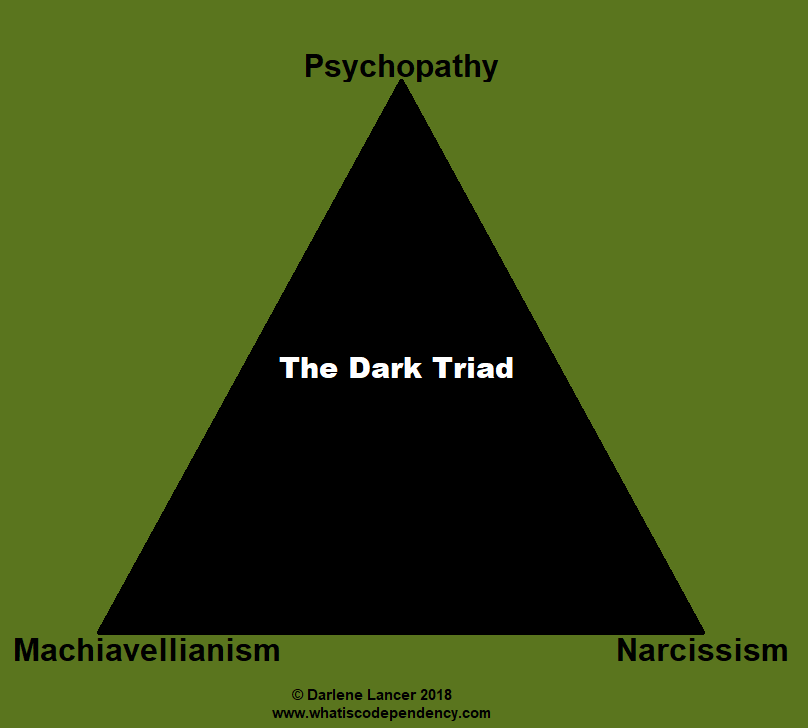 Think of the Dark Triad of Narcissism, Psychopathy, and Machiavellianism as the Bermuda Triangle – it’s perilous to get near it! The traits of all three often overlap and create personality profiles that are damaging and toxic, especially when it comes to intimate relationships, where we let our guard down.
One woman was the subject of identity fraud. Her bank accounts and credit cards were compromised. At the time, she was in love with her boyfriend who lived with her in her apartment. She was speaking regularly with the FBI and suffered extreme anxiety and emotionally stress. The authorities were unsuccessful in finding the culprit.
Her fiancé was very supportive in doing research to try to find him. He comforted her, occasionally bought her gifts, and paid her monthly rent out of money she gave him. When eventually the landlord confronted her about months of delinquency, she realized that the criminal was in fact her own boyfriend, who had been pocketing her rent money, except to buy her gifts. Her denial made it difficult to accept the truth about his ruthless gaslighting.
What is the Dark Triad
This popular term was coined in 2002 by Paulhus and Williams. Dark Triad refers to three unusually negative personality traits—narcissism, psychopathy, and Machiavellianism. The latter two share more traits with each other than with narcissists. Generally, the term refers to individuals with “subclinical” symptoms, meaning that they may not necessarily fully have narcissistic personality disorder (NPD) or anti-social personality disorder (ASPD). Machiavellianism arose out of Machiavelli’s philosophy and is not a mental health disorder.
Think of the Dark Triad of Narcissism, Psychopathy, and Machiavellianism as the Bermuda Triangle – it’s perilous to get near it! The traits of all three often overlap and create personality profiles that are damaging and toxic, especially when it comes to intimate relationships, where we let our guard down.
One woman was the subject of identity fraud. Her bank accounts and credit cards were compromised. At the time, she was in love with her boyfriend who lived with her in her apartment. She was speaking regularly with the FBI and suffered extreme anxiety and emotionally stress. The authorities were unsuccessful in finding the culprit.
Her fiancé was very supportive in doing research to try to find him. He comforted her, occasionally bought her gifts, and paid her monthly rent out of money she gave him. When eventually the landlord confronted her about months of delinquency, she realized that the criminal was in fact her own boyfriend, who had been pocketing her rent money, except to buy her gifts. Her denial made it difficult to accept the truth about his ruthless gaslighting.
What is the Dark Triad
This popular term was coined in 2002 by Paulhus and Williams. Dark Triad refers to three unusually negative personality traits—narcissism, psychopathy, and Machiavellianism. The latter two share more traits with each other than with narcissists. Generally, the term refers to individuals with “subclinical” symptoms, meaning that they may not necessarily fully have narcissistic personality disorder (NPD) or anti-social personality disorder (ASPD). Machiavellianism arose out of Machiavelli’s philosophy and is not a mental health disorder.
- Narcissism is characterized by the pursuit of ego gratification, vanity, and a sense of superiority, grandiosity, dominance, and entitlement.
- Machiavellianism is marked by manipulation – a calculating, duplicitous and amoral personality, focused on self-interest and personal gain.
- Psychopathy is distinguished by callousness, impulsivity, and enduring antisocial and bold behavior.
Deception
All three personalities lack honesty and humility, which includes sincerity, faithfulness, lack of greed, and fai ess. A study of cheating revealed that all three cheat when the risk of getting caught is low. When the risk is high, psychopaths and Machiavellians (when their energy for thinking is low) cheat. Both will intentionally lie. Narcissists have high levels of self-deception rather than intentional dishonesty.Psychosocial consequences
The comparative research examined a variety of behaviors, including aggression (bullying, sadism, aggression, and violence), erratic lifestyle (impulsivity, risk taking, and substance use), sexual activity (bizarre fantasies, infidelity, and sexual harassment), socio-emotional deficits (lack of empathy, low emotional intelligence, and theory of mind, i.e., to attribute own and others’ mental states), poor well-being (depression, loneliness, and stress), interpersonal problems (dominance, entitlement, and self-aggrandizement), immorality (lack of values, “deadly sins,” and moral disengagement, i.e. “standards don’t apply to me”), and antisocial tactics (cheating, lying, and negative humor). Machiavellians and psychopaths scored higher in these psychosocial issues; psychopaths twice as high as narcissists. The highest scores were among psychopaths, with aggression being the highest trait. Narcissists scored in the categories of aggression, sexual issues, interpersonal difficulties, and antisocial tactics. Among all three personalities, most of the high scores were due to psychopathic traits. When those were controlled (removed), narcissism still accounted for interpersonal difficulties.Callousness
To further understand the lack of empathy among the Dark Triad personalities, researchexamined affective empathy, which is the ability to have an appropriate emotional response to others’ emotions, and cognitive empathy, the ability to disce others’ emotional states. They found that all three personality types lacked affective empathy, but had unimpaired cognitive empathy. Creepily, all three felt positive looking a sad faces and felt negative seeing happy images! Narcissists and psychopaths also felt good seeing angry faces. Psychopaths liked seeing fearful faces. Overall empathy was lowest among psychopaths and Machiavellians, and study participants who were high on any of the three personality profiles had the lowest affective empathy. Narcissists scored highest on cognitive empathy. The fact that these people are insensitive to others feelings, while retaining the ability to assess others’ emotions, allows them to strategically manipulate people, while ignoring the harm they inflict. To find out if you or someone you know may qualify, see the Dark Triad test. Protect Yourself If you think you may be involved with a Dark Triad personality, seek psychotherapy. Don’t be afraid to talk to others about your experience. Covering up bad behavior is a common, but dangerous form of denial. Learn about narcissistic abuse, subtle forms of abuse,abusive relationships,andnarcissistic relationships. Find out How to Be Assertiveand read Dealing with a Narcissist. Violence is preceded by emotional abuse. If you’ve been threatened with violence, don’t wait for it to happen or trust that it won’t be repeated! © Darlene Lancer 2018Article author
About the Author
Darlene Lancer is a Licensed Marriage and Family Therapist, author of Codependency for Dummies, and Conquering Shame and Codependency: 8 Steps to Freeing the True You. She's an expert in relationships, codependency, and addiction, having worked with individuals and couples for 27 years. She maintains private practice in Santa Monica, CA and coaches internationally. For more information, see http://www.whatiscodependency.com to receive a FREE Report, "14 Tips for Letting Go," and find links to her books and ebooks, including: "Dealing with a Narcissist," "How to Speak Your Mind - Become Assertive and Set Limits,""I´m Not Perfect-I´m Only Human"- How to Beat Perfectionism and "10 Steps to Self-Esteem: The Ultimate Guide to Stop Self-Criticism." Watch her Youtube, "Codependency: What It Is and What It Feels Like."
You can follow her on Facebook at http://www.facebook.com/codependencyrecovery
Further reading
Further Reading
Article
Live A Happy Married Life by Resolving Conflicts in Marriage
Param Pujya Dadashri and Hirabaâs married life was full of peace, mutual respect and humility. Their worldly conduct and interactions were idyllic, so much so that family and friends noticed their unity and love for each other. For instance, Hiraba would visit the local vegetable market daily, she would ask Param Pujya Dadashri, âWhat vegetables should I buy?â Thus, performing her duty of asking and He would reply, âBuy whatever you would like, therefore fulfilling Hi
April 3, 2025
Article
A Look at Avoidant Attachment Styles and How They Work
The early development of avoidant attachment creates a coping mechanism that forms in childhood. Disconnected parent-child interactions typically trigger this condition. People who develop this attachment style learn to depend on their resources. They avoid deep emotional connections. People with this attachment style want intimacy, yet they remain afraid of becoming dependent on others. Understanding Avoidant Attachment Among the four primary attachment styles, avoidant atta
February 6, 2025
Article
Do You Really Understand The Swinger Life-Style?
So, you want to Play swinging? Do you like the idea of having sex with several attractive people, with no strings attached? Want the chance to explore your fantasies with like-minded people? Love having the intimacy and long-term commitment of your partner, but don't want to miss out on the opportunity for sexual exploration and variety? If this sounds like something you'd like to try, the increasingly popular lifestyle known as 'swinging' could be for you. What's so shocking
August 29, 2024
Article
Best Swinger Websites for Couples Looking for Local Swingers
Even if you don't have a swing club near you, the online swinger dating website is a good choice for you. In recent years, online dating sites have become increasingly popular, and swinging has become one of the most popular lifestyles for married couples and bisexual people. If you are looking for a swinger couple, here are some swinger dating websites where you can enjoy an adult swing. Adult Friend FinderrnAFF is the worldâs largest sex community and swinger dating site.
August 29, 2024