How to Identify and Combat Gaslighting
Written by Darlene Lancer, LMFT

Identifying gaslighting behavior and knowing how to combat gaslighting are essential to maintaining your self-esteem, and mental and emotional health.
Gaslighting is a form of narcissistic abuse that's used not only by narcissists, but also by sociopaths, addicts, and other abusers. Sometimes it's intentional, and sometimes it has become a habit to hide and maintain power.
Understanding Gaslighting
The term gaslighting comes from the movie Gaslight with Charles Boyer and Ingrid Bergman in which the character played by Boyer slowly tries to make Bergman's character think that she's losing her mind in order to steal from her.
Gaslighting is not an occasional lie or denial. It's a pattern of behavior calculated to make you trust the perpetrator, confuse you, and make you doubt your own perceptions, sanity, memory, or feelings. It's based on the need for control or concealment – often of an affair or gambling, or financial information or losses.
You can recognize gaslighting by the 5 M’s:
- Methodical
- Malicious
- Manipulation
- Motive: to undermine your
- Mind
Identifying Gaslighting Behavior
There are three categories of gaslighting behavior. The first are statements that devalue you and demean your opinions, feelings, perceptions, or memory.
Demeaning Statements
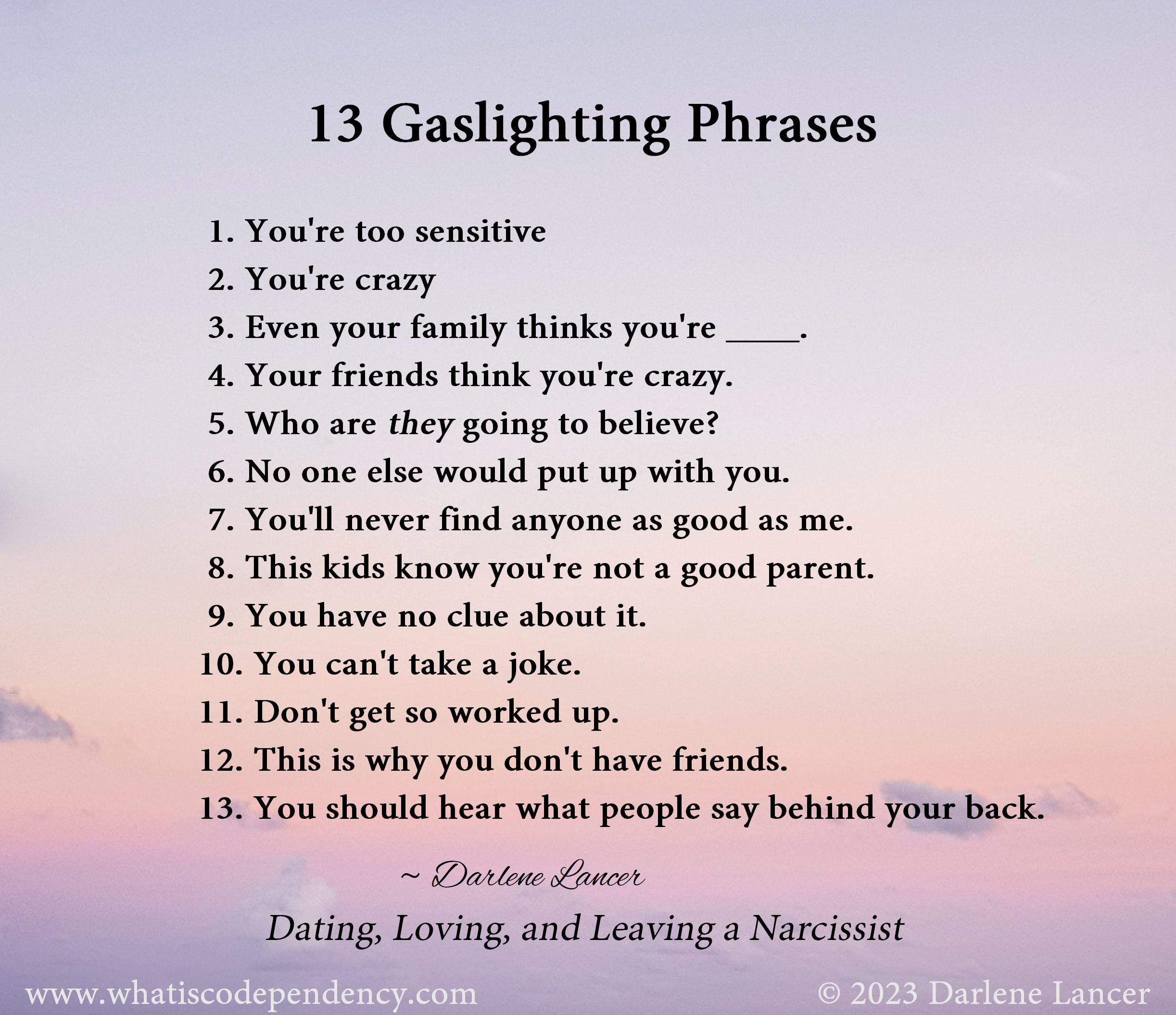 Demeaning statements are intended to undermine your self-esteem and self-trust. Many abusers use manipulation and emotional abuse to control you without gaslighting.
You should set personal boundaries and object to being demeaned. Some examples of demeaning statements are:
- You're overreacting.
- What's wrong with you?
- You're so sensitive!
- You sound crazy.
- You're hysterical.
- You're imagining things.
- Your memory isn't what it used to be.
Distortions of Reality
A gaslighter will distort reality to make you doubt your sanity and distrust your perceptions and experience. This can include:
- Lying; denial of their behavior
- Made-up false accusations against you
- Fabrication of stories that never happened, like, "When we dined with the Smiths, you had too much to drink ... You don't remember? You must have blacked out."
- Hiding your belongings
- Shifting the blame onto you when confronted
- Spreading rumors and lies about you
- Trivializing your feelings and opinions
Fake Conce
Conce is expressed to hide the gaslighter's plan and culpability. Fake conce s are meant to build trust and confuse you. This behavior includes:
- Loving gestures, including gifts and affection
- Fake concern; e.g., "You haven't been yourself lately. I'm worried about you."
- Flattery
- Seduction
How to Combat Gaslighting: What Victims Should Do
Gaslighting is very serious. It can damage you mentally and emotionally. Read more about gaslighting and its effect on victims, and take these steps:
- Get information.
- Write down conversations and what you felt.
- Pay attention to attempts to avoid responsibility and deny your experience.
- Notice when conversations are turned around to attack you (i.e., DARVO).
- Validate your feelings.
- Write down the person's behavior patterns.
- Notice discrepancies between their words and actions.
- Remember QTIP: "Don't Take It Personally." Ignore their words. Realize they're untrue and you're not the cause.
- Disengage from manipulative conversations.
- Don't isolate! Talk to people you trust to get a reality check.
- Get professional support.
You may be dealing with someone with a personality disorder. Don't wait to change them. Get help for yourself to learn how to combat gaslighting. Read Dating, Loving, and Leaving a Narcissist: Essential Tools for Improving or Leaving Narcissistic and Abusive Relationships to strengthen yourself and improve and change the power dynamics in the relationship. You will then be able to evaluate whether to stay, as well as have the strength to leave.
© Darlene Lancer 2024
Article author
About the Author
I'm a Licensed Marriage and Family Therapist and author of Dating, Loving, and Leaving a Narcissist: Essential Tools for Improving or Leaving Narcissistic and Abusive Relationships," Conquering Shame and Codependency: 8 Steps to Freeing Your True Self and Codependency for Dummies. and the 7 ebooks, including 10 Steps to Self-Esteem: The Ultimate Guide to Stop Self-Criticism, Spiritual Transformation in the Twelve Steps, "I'm Not Perfect - I'm Only Human" - How to Beat Perfectionism, Freedom from Guilt and Blame - Finding Self-Forgiveness, and How to Speak Your Mind: Become Assertive and Set Limits.
I've worked with countless individuals and couples for more than 35 years to recover from trauma and codependency. I'm an expert on narcissism, relationships, and codependency. See www.whatiscodependency.com and www.darlenelancer.com. See my website for FREE podcasts, meditations, and resources.
I've helped many individuals and couples find their way to more productive lives, happier marriages, and also to amicably separate.
My training includes psychoanalytic psychotherapy, EFT, family systems, trauma work, cognitive-behavioral, dream analysis, gestalt, and hypnotherapy.
I maintain a private practice in Santa Monica, and coach people internationally. See my website Service page for more information. Consultation by appointment: 310-458-0016. See my website to get a free report on 14 Steps for Letting Go.
Further reading
Further Reading
Article
A Look at Avoidant Attachment Styles and How They Work
The early development of avoidant attachment creates a coping mechanism that forms in childhood. Disconnected parent-child interactions typically trigger this condition. People who develop this attachment style learn to depend on their resources. They avoid deep emotional connections. People with this attachment style want intimacy, yet they remain afraid of becoming dependent on others. Understanding Avoidant Attachment Among the four primary attachment styles, avoidant atta
February 6, 2025
Article
Do You Really Understand The Swinger Life-Style?
So, you want to Play swinging? Do you like the idea of having sex with several attractive people, with no strings attached? Want the chance to explore your fantasies with like-minded people? Love having the intimacy and long-term commitment of your partner, but don't want to miss out on the opportunity for sexual exploration and variety? If this sounds like something you'd like to try, the increasingly popular lifestyle known as 'swinging' could be for you. What's so shocking
August 29, 2024
Article
The Advantages of a Web-Based Swinger Dating Service
Web-based swapping dating services can help you find a long-term swap relationship in the comfort of your home. These types of services can provide singles with information about like-minded people and help them get in touch with other couples. To use dating expertise, you need to register together. When registering to use the service, you need to provide more information as well as your contact information and interests. Maintaining your information conveniently will help yo
August 29, 2024
Article
Dr. Venus Nicolino: You Have To Make Yourself Available To Find Good Relationships
The idea of making yourself more desirable by making yourself less available doesn't make a lot of sense when you think about it. After all, Juliet would have plunged a premature dagger into the heart of her romance with Romeo if she hid in her room rather than go out on her balcony. The end of Sleepless in Seattle shifts from "awww" to "aw, no" if one of the two main characters skips the trip to the Empire State Building. As these examples from fiction show, making yourself
August 16, 2024